
TL;DR
STEM education is no longer optional; it’s essential for preparing girls for a future driven by technology, innovation, and problem-solving. From artificial intelligence and robotics to healthcare and environmental science, STEM equips girls with the knowledge, confidence, and leadership skills needed to thrive in tomorrow’s world. Schools and parents who encourage STEM learning today are helping girls become tomorrow’s scientists, engineers, entrepreneurs, innovators, and changemakers.
The Short Answer
STEM education matters more than ever for girls because it builds critical thinking, creativity, digital literacy, confidence, and leadership while opening doors to some of the fastest-growing careers in the world. As technology transforms every industry, girls with STEM skills are better prepared to solve real-world challenges, contribute to innovation, and shape the future rather than simply adapt to it.
Introduction
Imagine a world where the next breakthrough cancer treatment, sustainable energy solution, or life-changing artificial intelligence system is created by a young girl sitting in today’s classroom.
That future is entirely possible.
The world is entering one of the fastest periods of technological transformation in history. Artificial Intelligence, Machine Learning, Robotics, Biotechnology, Data Science, Space Technology, Climate Engineering, and Cybersecurity are changing how we live, work, communicate, and solve problems.
Today’s students won’t simply use technology; they’ll be expected to build it, improve it, question it, and use it responsibly.
For girls, this represents an incredible opportunity.
STEM education (Science, Technology, Engineering, and Mathematics) gives girls the tools to become innovators, leaders, researchers, entrepreneurs, doctors, architects, engineers, environmental scientists, AI specialists, and much more.
More importantly, STEM teaches something even greater than technical knowledge; it teaches girls how to think.
Why Is STEM Education So Important Today?
The careers of tomorrow look very different from those of the past.
According to global workforce studies, digital and analytical skills are becoming increasingly valuable across nearly every profession.
Whether someone wants to become:
- A doctor
- A business leader
- A fashion designer
- An architect
- A lawyer
- A teacher
- A scientist
- A game developer
- An entrepreneur
STEM skills improve their ability to succeed.
The future belongs to people who can:
- Solve problems
- Analyze information
- Think creatively
- Adapt quickly
- Use technology effectively
- Continue learning throughout life
These are exactly the abilities STEM education develops.
Why Girls Need STEM More Than Ever
For many years, women have been underrepresented in engineering, technology, computer science, and several scientific disciplines.
The reasons are complex.
Many girls simply haven’t received enough encouragement or exposure to STEM opportunities during childhood.
Others mistakenly believe science or mathematics is “too difficult” or “not meant for girls.”
Fortunately, that perception is changing.
Today, girls are leading research laboratories, launching technology startups, designing spacecraft, developing AI systems, discovering medicines, and solving global environmental challenges.
Schools now have an important responsibility, not just to teach STEM but to inspire girls to see themselves as future innovators.
STEM Is About Much More Than Science
One of the biggest misconceptions is that STEM simply means studying difficult mathematics.
It doesn’t.
Modern STEM education combines creativity, communication, teamwork, curiosity, innovation, and technology.
Students might:
- Design a robot
- Build a mobile application
- Create sustainable engineering models
- Develop simple AI projects
- Analyze climate data
- Solve real-world community problems
- Conduct scientific experiments
- Build prototypes
- Learn coding
- Present solutions confidently
These experiences prepare students for challenges that textbooks alone cannot teach.
The Skills Girls Gain Through STEM Education
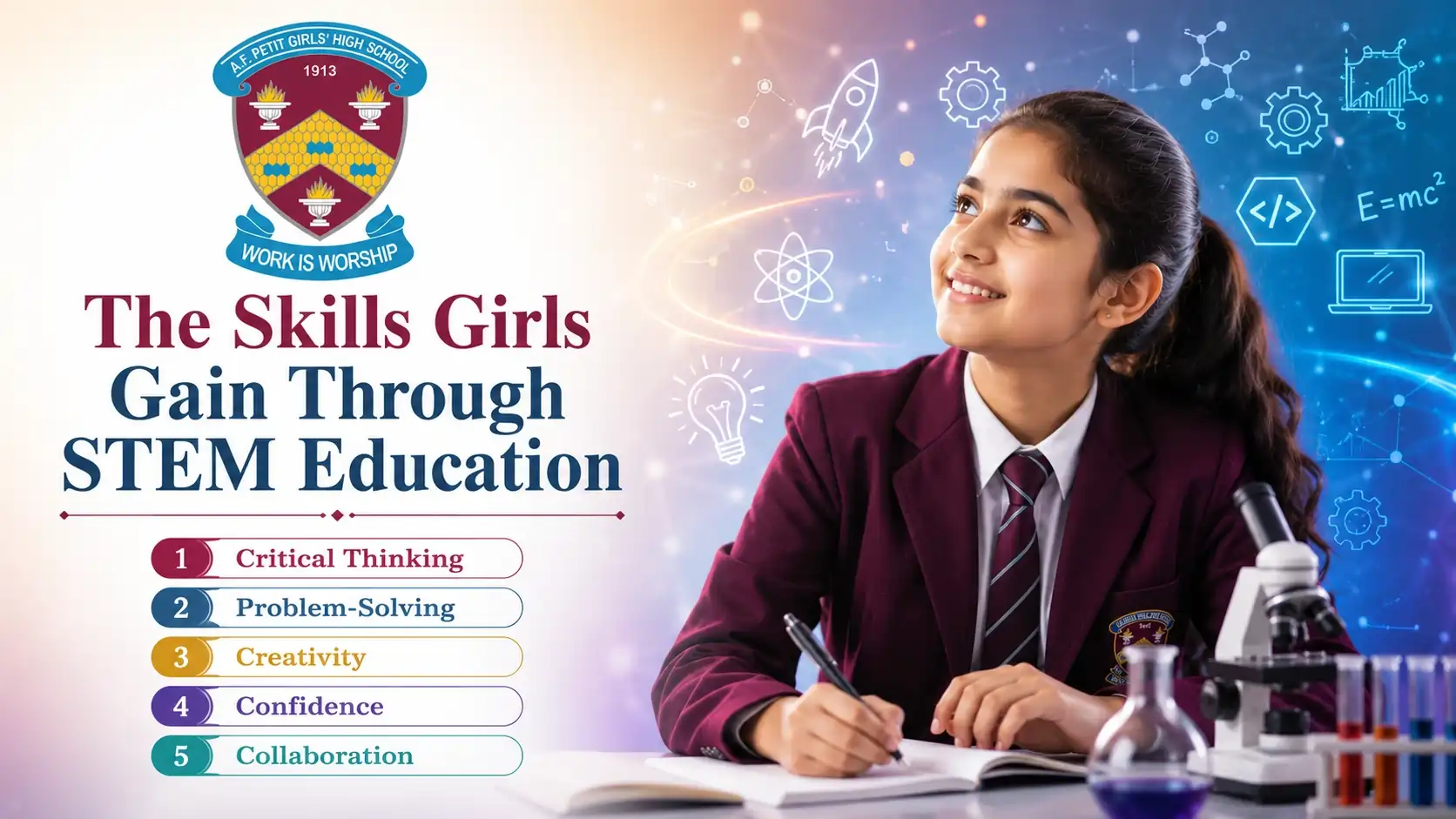
1. Critical Thinking
Instead of memorizing answers, STEM teaches students to ask better questions.
Girls learn to evaluate information, analyze evidence, and develop logical solutions.
This ability benefits every subject, not just science.
2. Problem-Solving
Life presents problems every day.
Whether designing a bridge, writing computer code, diagnosing diseases, or managing a business, successful professionals solve problems.
STEM develops this mindset from an early age.
3. Creativity
Innovation doesn’t happen without imagination.
Designing sustainable cities, creating medical devices, or inventing environmentally friendly technologies all require creative thinking.
Great STEM education encourages experimentation and original ideas.
4. Confidence
Completing projects, solving engineering challenges, and presenting scientific ideas helps girls believe in their own abilities.
Confidence developed through STEM often carries into leadership roles, public speaking, and future careers.
5. Collaboration
Most real-world innovations happen in teams.
STEM activities encourage collaboration, communication, and respect for different perspectives.
Girls learn how to contribute ideas while working with others toward common goals.
How STEM Builds Future Leaders
Leadership isn’t only about managing people.
It’s about making informed decisions.
It means:
- Solving challenges calmly.
- Thinking independently.
- Communicating ideas clearly.
- Learning from failure.
- Taking initiative.
Project-based STEM education naturally develops these leadership qualities.
When students build prototypes, conduct research, or solve practical challenges together, they become confident decision-makers.
Artificial Intelligence Is Making STEM Even More Important
Artificial Intelligence is already changing:
- Healthcare
- Banking
- Agriculture
- Education
- Transportation
- Manufacturing
- Entertainment
- Retail
- Finance
Children entering school today will likely work alongside AI throughout their careers.
That doesn’t mean every student must become a programmer.
Instead, girls should understand:
- How AI works
- Ethical use of technology
- Data literacy
- Digital citizenship
- Responsible innovation
- Human-centered problem-solving
These are becoming essential life skills.
Why Early Exposure Matters
Research consistently shows that children begin developing interests and beliefs about subjects from an early age.
Positive STEM experiences during primary and middle school can significantly influence future confidence and career aspirations.
Simple activities such as:
- Building models
- Conducting experiments
- Coding games
- Nature exploration
- Mathematics puzzles
- Robotics clubs
Help students associate STEM with curiosity rather than difficulty.
Schools that make STEM enjoyable create lifelong learners.
Common Myths About Girls and STEM
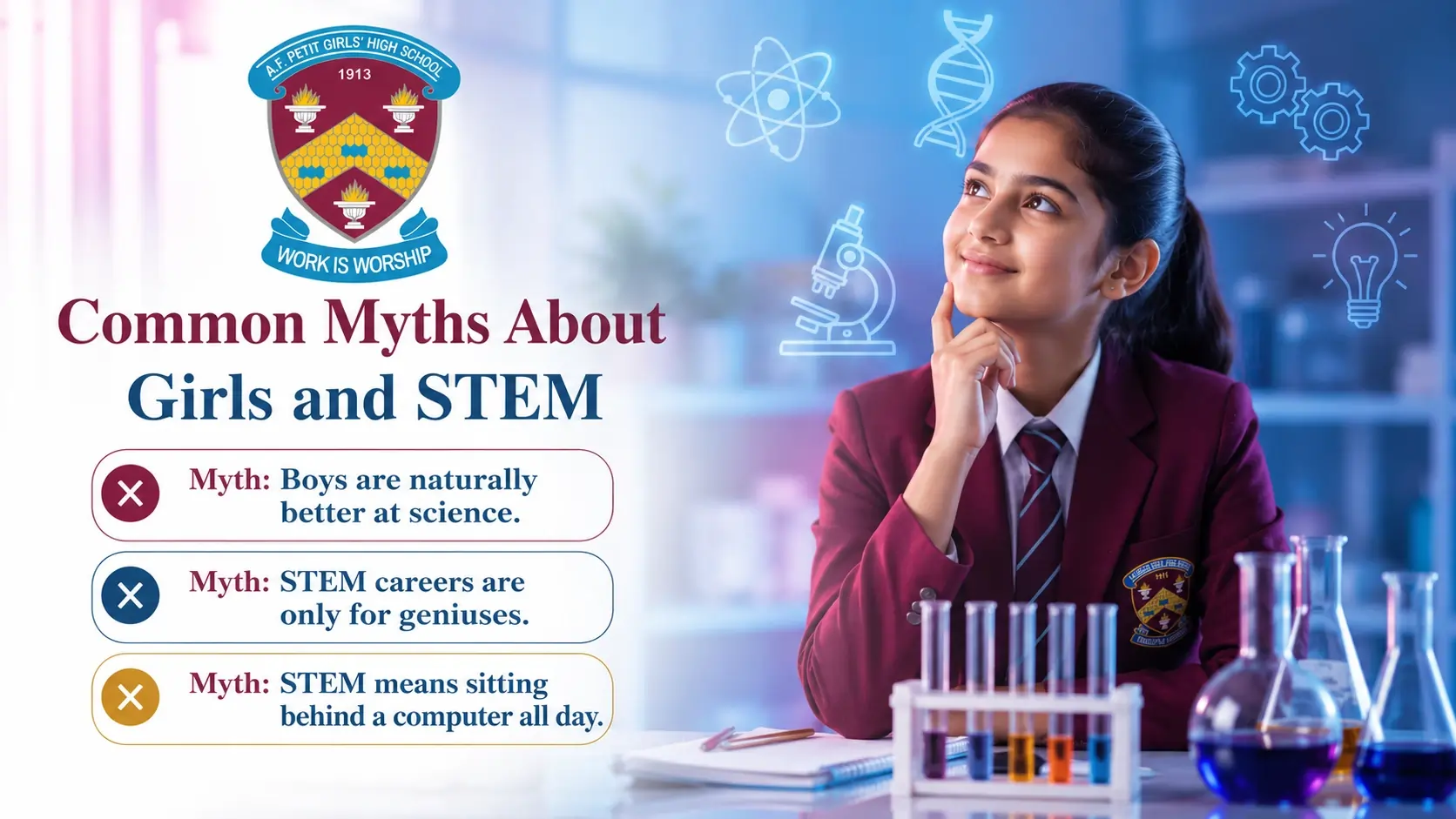
Myth: Boys are naturally better at science.
Reality:
Research has repeatedly shown that girls perform equally well in mathematics and science when provided with supportive learning environments and equal opportunities.
Myth: STEM careers are only for geniuses.
Reality:
Success in STEM depends far more on curiosity, persistence, teamwork, and continuous learning than on natural talent.
Myth: STEM means sitting behind a computer all day.
Reality:
STEM careers include:
- Medicine
- Environmental conservation
- Space exploration
- Biomedical engineering
- Architecture
- Renewable energy
- Product design
- Agriculture
- Sports science
- Psychology research
- Marine biology
The possibilities are enormous.
How Schools Can Inspire More Girls to Love STEM
The most effective schools don’t just teach STEM; they create experiences.
Examples include:
Project-Based Learning
Students solve practical challenges rather than simply complete worksheets.
Robotics Clubs
Students build, test, and improve robotic systems while learning teamwork.
Coding Activities
Programming encourages logical thinking and creativity.
Science Exhibitions
Presenting projects publicly develops communication skills and confidence.
Innovation Challenges
Students work together to solve real-world environmental or social problems.
Female STEM Role Models
Inviting women scientists, engineers, doctors, entrepreneurs, and researchers to interact with students inspires future aspirations.
What Parents Can Do at Home
Parents don’t need technical backgrounds to encourage STEM.
They can:
- Encourage questions.
- Read science books together.
- Visit science museums.
- Explore astronomy.
- Build simple experiments.
- Support coding platforms.
- Watch educational documentaries.
- Celebrate curiosity.
- Encourage daughters to solve problems independently.
Most importantly, praise effort, not perfection.
Confidence grows through persistence.
STEM Careers Girls Should Watch in the Next Decade
The fastest-growing careers include:
- Artificial Intelligence Specialist
- Robotics Engineer
- Data Scientist
- Cybersecurity Expert
- Biomedical Engineer
- Environmental Scientist
- Climate Researcher
- Aerospace Engineer
- Biotechnology Researcher
- Renewable Energy Engineer
- UX Designer
- Health Technology Specialist
- Digital Product Designer
Many of these careers barely existed twenty years ago.
The next generation will create entirely new professions.
Girls prepared with STEM skills will be ready to lead them.
Real Women Inspiring the Next Generation
Girls benefit from learning about women who have transformed science and technology.
Examples include:
- Kalpana Chawla, whose journey inspired millions to dream beyond boundaries.
- Tessy Thomas, known for her leadership in India’s missile program.
- Gagandeep Kang, a globally respected Indian scientist in public health and virology.
- Katherine Johnson, whose mathematical expertise helped make space exploration possible.
- Fei-Fei Li, a leading researcher in artificial intelligence and computer vision.
Their achievements demonstrate that talent, determination, and education, not gender, shape success in STEM.
Final Thoughts
STEM education is not just about preparing girls for specific careers; it is about preparing them for life in a rapidly changing world.
By nurturing curiosity, encouraging experimentation, and providing opportunities to explore science and technology, schools and parents empower girls to become confident learners, ethical innovators, and future leaders.
The question is no longer whether girls should study STEM. The real question is how we can ensure every girl has the opportunity to discover her potential.
Key Takeaways
- STEM education equips girls with the skills needed to thrive in an innovation-driven world.
- Early exposure to science, technology, engineering, and mathematics builds confidence, curiosity, and resilience.
- Schools and parents share the responsibility of creating supportive, engaging STEM learning experiences.
- STEM opens doors to diverse careers, from healthcare and environmental science to AI, robotics, and entrepreneurship.
- Empowering girls through STEM today helps build a more inclusive, innovative, and future-ready society.
Frequently Asked Questions
STEM education equips girls with critical thinking, creativity, digital literacy, confidence, and problem-solving skills while opening pathways to future-ready careers.
Children can begin exploring STEM concepts as early as preschool through age-appropriate experiments, puzzles, building activities, coding games, and curiosity-driven learning.
No. STEM skills benefit careers across healthcare, business, design, education, law, environmental science, entrepreneurship, and many other fields.
Support curiosity, provide hands-on learning experiences, explore educational resources together, visit museums, and celebrate effort instead of focusing only on results.
Yes. As AI becomes integrated into everyday life and work, understanding technology, data, ethics, and problem-solving will become increasingly valuable for students in every career.