In today’s rapidly changing world, success is no longer determined by how much a student can memorise. Instead, it depends on how effectively they can analyse information, solve problems, ask thoughtful questions, and make informed decisions. While memorisation has its place in learning, critical thinking is the skill that empowers students to apply knowledge in meaningful ways.
At Avabai Petit School, we believe education should go beyond remembering facts. As an ICSE girls’ school, our approach focuses on nurturing curious, independent thinkers who are prepared not only for examinations but also for higher education, careers, leadership, and life.
This article explores why critical thinking has become one of the most important skills for students and how a learning environment that encourages inquiry and exploration helps girls become confident learners and future leaders.
What Is Critical Thinking?
Critical thinking is the ability to:
- Analyse information objectively
- Evaluate evidence before forming opinions
- Solve unfamiliar problems
- Think creatively
- Ask meaningful questions
- Make informed decisions
- Apply knowledge to real-life situations
Unlike rote memorisation, which focuses on recalling information, critical thinking helps students understand why, how, and when to use what they have learned.
For example:
A student may memorise Newton’s Laws of Motion for an examination.
A critical thinker, however, can explain why seat belts save lives, predict the outcome of a moving object, and connect scientific principles to everyday experiences.
That understanding lasts far longer than memorised definitions.
Why Memorisation Alone Is No Longer Enough
The world students will enter after school is vastly different from previous generations.
Information is available instantly through technology. Employers and universities increasingly value students who can:
- Think independently
- Solve complex problems
- Collaborate with others
- Communicate ideas clearly
- Adapt to new situations
- Innovate with confidence
Remembering textbook answers may help in some examinations, but it rarely prepares students for real-world challenges.
Today’s learners need to understand concepts deeply so they can apply them in unfamiliar situations.
The Myth: "Good Marks Only Come from Rote Learning"
One of the most common misconceptions among parents is that memorising answers guarantees academic success.
While memorisation can help students recall formulas, definitions, or historical dates, it often falls short when examinations assess understanding, application, and reasoning.
Modern assessments, particularly within the ICSE curriculum, increasingly reward students who can:
- Interpret information
- Explain concepts
- Compare ideas
- Analyse situations
- Apply knowledge in different contexts
Students who genuinely understand a concept often perform better because they can answer both familiar and unexpected questions with confidence.
How Critical Thinking Improves Academic Performance
Many parents assume that encouraging discussion and exploration takes time away from studies.
In reality, it strengthens academic outcomes.
When students understand concepts instead of memorising them:
- Learning becomes easier
- Revision becomes more meaningful
- They retain information longer
- They perform better in application-based questions
- They become more confident during examinations
Understanding creates long-term learning, whereas memorisation often fades soon after exams.
How Avabai Petit School Encourages Critical Thinking
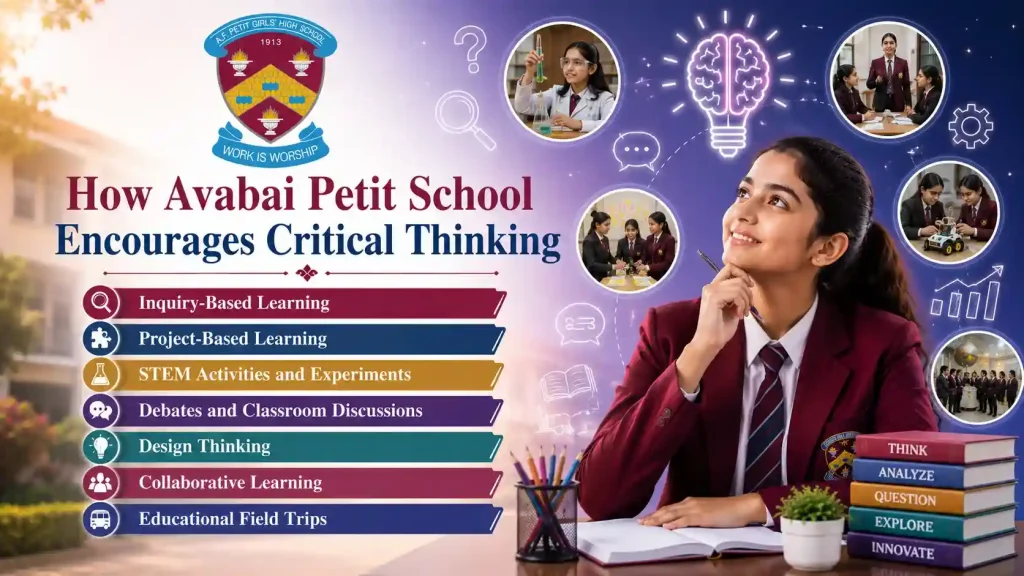
At Avabai Petit School, learning is designed to help girls become active participants rather than passive recipients of information.
Inquiry-Based Learning
Teachers encourage students to ask questions before providing answers.
Instead of simply explaining a scientific concept, students investigate, observe, and discover patterns themselves.
This curiosity develops analytical thinking from an early age.
Project-Based Learning
Projects allow students to research topics, collaborate with classmates, analyse findings, and present their conclusions.
Whether exploring environmental sustainability or local history, students learn how classroom knowledge connects to the real world.
STEM Activities and Experiments
Science and mathematics become exciting when students test ideas through practical experiments.
Rather than memorising formulas, students learn why those formulas work.
Hands-on STEM activities help develop observation, reasoning, and problem-solving skills.
Debates and Classroom Discussions
Healthy discussions encourage students to:
- Listen respectfully
- Consider multiple viewpoints
- Support opinions with evidence
- Think before responding
These experiences build confidence while strengthening communication and reasoning.
Design Thinking
Students learn to:
- Identify problems
- Understand different perspectives
- Generate ideas
- Test solutions
- Improve based on feedback
This process nurtures creativity alongside logical thinking.
Collaborative Learning
Working in teams teaches students that many problems have multiple solutions.
Collaboration develops:
- Leadership
- Communication
- Decision-making
- Empathy
- Responsibility
These are essential life skills that extend well beyond academics.
Educational Field Trips
Learning outside the classroom transforms abstract concepts into real experiences.
A visit to a museum, science centre, heritage site, or nature reserve encourages students to observe, question, and connect classroom learning with the world around them.
These experiences make learning memorable because students discover knowledge firsthand rather than simply reading about it.
Real-Life Classroom Example
Imagine a Class VI science lesson on water conservation.
Instead of asking students to memorise methods of saving water, teachers divide the class into small groups.
Each team investigates water usage within the school, identifies areas where water is wasted, proposes practical solutions, and presents recommendations to classmates.
Students are not simply learning about conservation; they are analysing data, solving problems, communicating ideas, and thinking like responsible citizens.
That is critical thinking in action.
Another Example: Mathematics Beyond Memorisation
A mathematics lesson may begin with a real-life budgeting challenge rather than a formula.
Students calculate costs, compare options, justify decisions, and explain their reasoning.
They are learning mathematics while simultaneously developing financial awareness and logical thinking.
This approach helps students appreciate why mathematics matters in everyday life.
Why Critical Thinking Matters Beyond School
Critical thinking prepares students for every stage of life.
It helps them:
- Make responsible decisions
- Solve unfamiliar problems
- Adapt to changing technologies
- Communicate effectively
- Become confident leaders
- Evaluate online information responsibly
- Build resilience
- Think independently
These qualities are essential in higher education, entrepreneurship, research, business, healthcare, technology, law, public service, and countless other fields.
The ICSE Advantage
The ICSE curriculum is recognised for encouraging conceptual understanding rather than surface-level learning.
Students regularly engage in:
- Analytical writing
- Practical investigations
- Literature interpretation
- Project work
- Research assignments
- Application-oriented assessments
This emphasis naturally supports the development of critical thinking while maintaining strong academic standards.
How Parents Can Encourage Critical Thinking at Home
Schools play an important role, but learning continues at home.
Parents can encourage critical thinking by:
- Asking open-ended questions
- Encouraging children to explain their reasoning
- Allowing them to make age-appropriate decisions
- Reading together and discussing different viewpoints
- Playing strategy games and puzzles
- Supporting curiosity instead of immediately giving answers
- Encouraging exploration and creativity
Small daily conversations often become powerful learning opportunities.
Final Thoughts
Knowledge remains important, but in today’s world, knowing how to think is even more valuable than knowing what to remember.
Students who develop curiosity, confidence, creativity, and analytical thinking are better prepared for examinations, university education, professional success, and responsible citizenship.
At Avabai Petit School, we are committed to creating a learning environment where every girl is encouraged to question, explore, collaborate, and think independently. By combining the strengths of the ICSE curriculum with inquiry-based learning, STEM education, collaborative projects, debates, design thinking, and experiential learning, we help our students build the skills they need not only to achieve academic excellence but also to thrive in an ever-changing world.
Ready to Learn More?
If you’re looking for a school that nurtures confident, curious, and future-ready learners, enquire about admissions at Avabai Petit School. Discover how our holistic approach to education helps every girl develop the critical thinking skills needed for lifelong success.
No. Memorisation still has value for learning vocabulary, multiplication tables, formulas, and foundational facts. However, these should serve as building blocks for deeper understanding rather than being the final goal.
Yes. Students who understand concepts deeply are generally better equipped to answer application-based, analytical, and higher-order thinking questions, leading to stronger academic performance.
Critical thinking begins in early childhood through questioning, exploration, observation, and problem-solving. The earlier these habits are encouraged, the more naturally they develop over time.
Critical thinking helps girls develop confidence, independence, leadership, effective communication, and informed decision-making. These qualities empower them to succeed academically and thrive in higher education, careers, and leadership roles.