
Every parent wants their child to excel academically. While good study habits, quality teaching, and regular practice all play important roles, one factor is often overlooked: curiosity.
Curious students don’t just study because they have to; they learn because they genuinely want to understand the world around them. They ask questions, explore ideas, experiment with solutions, and connect classroom learning with real life. This deeper engagement often translates into stronger academic performance and better long-term success.
At Avabai Petit School, we believe that curiosity is not a distraction from learning; it’s the foundation of meaningful education. By encouraging students to ask questions, investigate ideas, and think independently, we help them become confident learners who are prepared for both examinations and life beyond the classroom.
Quick Answer
Curiosity improves academic performance because it increases motivation, strengthens memory, enhances critical thinking, encourages problem-solving, and helps students develop a deeper understanding of concepts rather than relying on memorisation alone. Research in education and cognitive science consistently shows that students who are curious become more engaged learners and achieve better long-term academic outcomes.
Why Curiosity Matters More Than Ever
Today’s students are preparing for careers that may not even exist yet.
Artificial Intelligence, automation, data science, sustainability, entrepreneurship, and global collaboration are changing how the world works. In this environment, success depends less on remembering information and more on knowing how to ask the right questions, analyse information, and apply knowledge creatively.
That’s exactly what curiosity develops.
Curious learners naturally:
- Explore beyond textbooks
- Connect ideas across subjects
- Enjoy discovering new concepts
- Learn independently
- Adapt quickly to new challenges
These qualities not only improve classroom performance but also prepare students for lifelong learning.
The Science Behind Curiosity and Learning
Educational research suggests that curiosity activates the brain’s reward system, making learning more enjoyable and memorable.
When students become interested in a topic:
- They pay closer attention.
- They retain information longer.
- They participate more actively.
- They develop stronger understanding.
- They are more likely to continue learning independently.
Instead of studying only to pass examinations, curious students seek understanding, and understanding leads to better academic performance.
How Curiosity Improves Academic Performance
1. Curiosity Makes Students More Engaged
Students learn best when they actively participate in lessons rather than passively listening.
When learners ask questions such as:
- Why does this happen?
- How does this work?
- What if we tried something different?
they become active participants in their education.
Greater engagement means:
- Better classroom participation
- Improved concentration
- Higher motivation
- Better learning outcomes
2. Curiosity Strengthens Memory
Memorising facts for an examination often leads to short-term recall.
Understanding why something happens creates lasting knowledge.
For example:
A student who memorises the water cycle may forget it after the examination.
A student who performs experiments, observes weather patterns, and discusses climate develops a much deeper understanding that lasts much longer.
Curiosity transforms information into meaningful knowledge.
3. Curious Students Develop Better Critical Thinking
Academic excellence today isn’t about remembering answers.
It’s about evaluating evidence, solving problems, and making informed decisions.
Students who regularly ask questions learn to:
- Analyse situations
- Compare ideas
- Identify patterns
- Evaluate evidence
- Form logical conclusions
These skills improve performance across subjects, from Mathematics and Science to English and Social Studies.
4. Curiosity Builds Better Problem Solvers
Real-world problems rarely have one correct answer.
Curious students enjoy exploring different possibilities before arriving at a solution.
Whether solving a mathematical problem, designing a science experiment, or writing an essay, curiosity encourages students to think creatively rather than simply follow instructions.
5. Curiosity Encourages Independent Learning
One of the biggest differences between average learners and outstanding learners is initiative.
Curious students don’t wait for teachers to provide every answer.
Instead, they:
- Read additional books.
- Conduct research.
- Explore educational resources.
- Ask meaningful questions.
- Learn beyond the syllabus.
This independence naturally leads to stronger academic performance.
How Avabai Petit School Encourages Curiosity Every Day
At Avabai Petit School, curiosity is woven into everyday learning experiences rather than being limited to occasional activities.
Our students are encouraged to explore, investigate, collaborate, and discover through:
Inquiry-Based Learning
Instead of simply providing answers, teachers encourage students to investigate questions, analyse evidence, and arrive at their own conclusions.
Project-Based Learning
Students work on meaningful projects that combine creativity, research, teamwork, and practical application of classroom concepts.
STEM Learning and Science Labs
Hands-on experiments help students experience scientific concepts rather than merely reading about them.
Learning becomes exciting because students observe, test, and discover.
Reading Culture
Books introduce students to new perspectives, ideas, cultures, and possibilities.
Our emphasis on reading encourages lifelong curiosity and independent thinking.
Educational Field Trips
Learning extends beyond classroom walls.
Visits to museums, industries, heritage sites, science centres, and cultural institutions allow students to connect theory with real-life experiences.
Research Projects
Students develop research skills by investigating topics independently, evaluating information, and presenting their findings confidently.
Student Discussions
Healthy classroom discussions teach students to ask better questions, appreciate different viewpoints, and express ideas clearly.
Clubs, Competitions, and Exhibitions
Whether participating in science exhibitions, literary activities, leadership programs, or creative competitions, students continuously explore new interests while developing confidence and communication skills.
A Classroom Example
Imagine a Science lesson on plants.
A traditional classroom may ask students to memorise the parts of a flower.
A curiosity-driven classroom asks:
- Why do flowers have different colours?
- Why do some plants grow faster?
- How do insects help plants survive?
- What happens if a plant doesn’t receive sunlight?
Students then perform experiments, observe changes, record findings, discuss results, and present conclusions.
The result?
They don’t just remember the lesson.
They truly understand it.
That understanding naturally reflects in assessments and examinations.
Common Myths About Curiosity
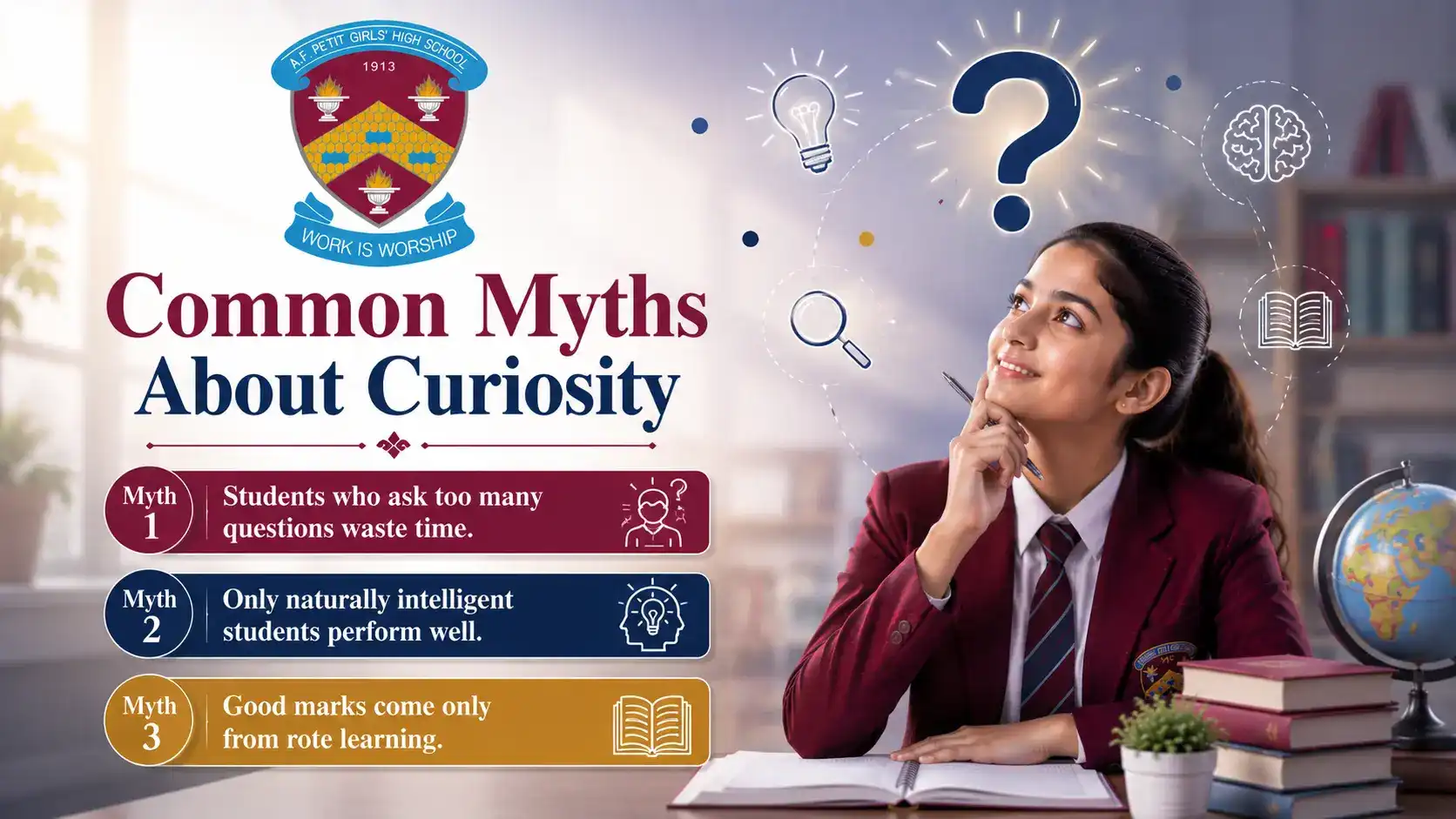
Myth 1: Students who ask too many questions waste time.
Reality: Thoughtful questions deepen understanding and improve learning for the entire class.
Myth 2: Only naturally intelligent students perform well.
Reality: Consistent curiosity, effort, and perseverance often matter more than natural ability.
Students who continuously explore and learn improve steadily over time.
Myth 3: Good marks come only from rote learning.
Reality: Modern education increasingly rewards conceptual understanding, application, critical thinking, and analytical skills.
Students who understand concepts perform better in higher-order questions and retain knowledge longer.
How Parents Can Encourage Curiosity at Home
Parents play a vital role in developing curious learners.
Simple everyday practices can make a big difference:
- Encourage children to ask questions without fear.
- Read together every day.
- Visit museums, science centres, libraries, and historical places.
- Allow children to experiment and explore safely.
- Ask open-ended questions during conversations.
- Praise effort and curiosity rather than only marks.
- Support hobbies and creative interests.
- Limit passive screen time and encourage meaningful exploration.
Curiosity grows when children feel safe to wonder, question, and discover.
Curiosity Builds Skills Beyond Academics
Academic success is only one outcome.
Curious learners also develop:
- Leadership
- Confidence
- Communication skills
- Creativity
- Innovation
- Entrepreneurial thinking
- Collaboration
- Problem-solving abilities
- Social responsibility
- Sportsmanship
- Artistic expression
- Adaptability
These qualities prepare students to succeed in higher education, future careers, and life.
Why This Matters in an AI-Driven World
With information readily available through search engines and AI tools, simply memorising facts is no longer enough.
The students who will thrive are those who know how to:
- Ask meaningful questions.
- Evaluate information critically.
- Solve unfamiliar problems.
- Learn continuously.
- Adapt to change.
Curiosity is becoming one of the most valuable skills for future success.
Schools that cultivate inquisitive minds today are preparing students to become tomorrow’s innovators, leaders, and responsible global citizens.
Final Thoughts
Academic excellence is not achieved simply by memorising facts or preparing for examinations. It grows from a genuine desire to understand, explore, question, and discover.
When students are encouraged to be curious, learning becomes meaningful. They retain knowledge more effectively, think independently, solve problems creatively, and approach new challenges with confidence.
At Avabai Petit School, curiosity is at the heart of learning. Through inquiry-based teaching, hands-on experiences, research opportunities, and a vibrant culture of exploration, we empower every girl to become an enthusiastic learner, a confident thinker, and a future-ready leader.
If you’re looking for a school where your daughter will be encouraged to ask questions, think critically, and achieve academic excellence through meaningful learning, contact Avabai Petit School today to learn more about our admissions process or schedule a campus visit.
Frequently Asked Questions
Yes. Curious students are generally more engaged, retain information better, develop stronger critical thinking skills, and achieve deeper conceptual understanding, all of which contribute to improved academic performance.
Absolutely. Schools and parents can nurture curiosity through inquiry-based learning, hands-on activities, meaningful discussions, reading, exploration, and opportunities for independent research.
Questions encourage students to think critically, explore different perspectives, clarify concepts, and develop deeper understanding instead of relying solely on memorisation.
Avabai Petit School promotes curiosity through inquiry-based learning, project-based learning, STEM education, science labs, reading culture, research projects, educational field trips, clubs, competitions, exhibitions, and student-led learning experiences.
Curiosity helps students build leadership, creativity, communication, confidence, innovation, collaboration, resilience, entrepreneurship, and problem-solving skills that benefit them throughout life.